Ten Months of Travel Abroad
Contents
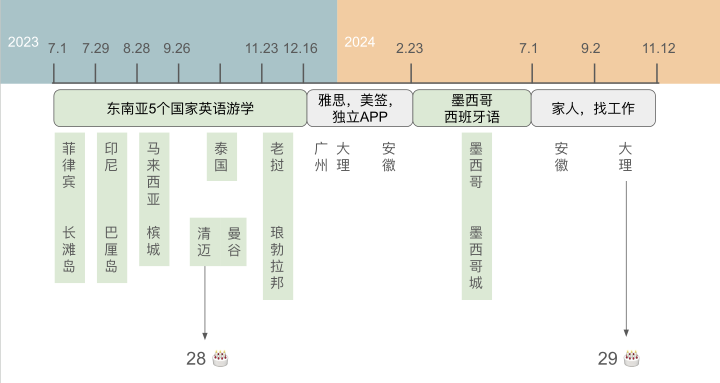
In June 2023, I left my job as a programmer at a foreign company in Shenzhen. On July 1, I departed from Hong Kong Airport and began my gap-year trip. It had two parts: six months traveling through five Southeast Asian countries, then two months back in China around the Spring Festival, followed by four months studying Spanish in Mexico. This article looks back on that gap year.
The original article was first published on the WeChat public account HaroldBlog.
0. The plan
Because it was my first time going abroad, I was anxious and not very confident about my English. My first thought was to study English overseas. Programs in Northern European countries such as Ireland were relatively expensive, so I ultimately chose the Philippines, which offered the best value in Southeast Asia.
For my other destinations, I followed recommendations from the digital-nomad travel site Nomad List, choosing Southeast Asian and Latin American cities popular with digital nomads. I had wanted to visit India, but could not obtain a visa, so I removed it from the itinerary.
Long-term rentals offer discounts, reduce transportation costs and the fatigue of constant moving, and allow a deeper understanding of local life. So I stayed in each city for at least about four weeks.
1. The Philippines 🇵🇭: Studying English in Boracay
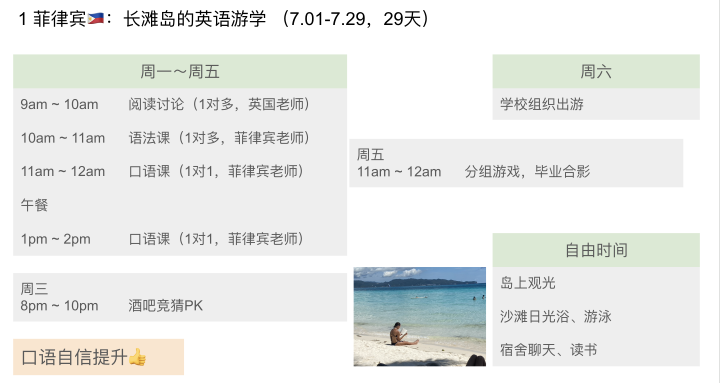
Choosing a language school: The Philippines has many intensive, long-hour language schools resembling Chinese cram schools, known as “Spartan” schools. They are mainly in cities such as Cebu and Baguio and are run by Korean or Japanese owners. My grammar foundation was solid, while speaking was my weak point, and I truly disliked that East Asian learning style. After consulting a Taiwanese traveler’s account, I chose a semi-vacation-style language school in Boracay run by a Canadian (the principal himself also taught classes and organized activities). At the time, I did not know I could use an agent, so I handled everything myself: I got no discount and even paid an extra bank-transfer fee to the Philippines. A Chinese-language agency accepted Alipay and offered a 20% discount.
Philippine tourist visa: I prepared documents and booked an interview through the Guangzhou Philippine Consulate General’s mini-program. In early 2023, just after the pandemic ended, there were many people waiting for Philippine visa interviews. New slots were released at fixed times each day, and I tried for several weeks before securing an in-person appointment two months later. The interview was in English. Documents included the school’s invitation letter, accommodation booking, visa application form, round-trip flight booking, and proof of funds. The approval rate was high.
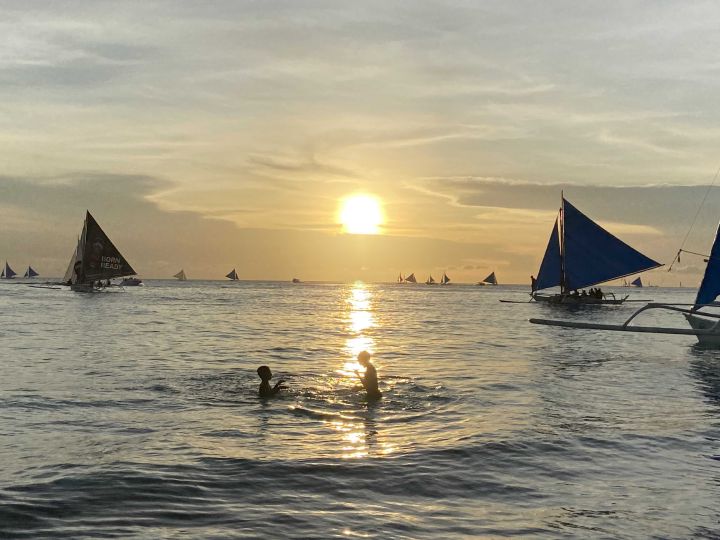
I have already shared my learning experience in Boracay in My Study-Abroad Diary in the Philippines. Boracay is a famous Philippine tourist destination, a separate island reachable only by boat, and it felt very safe. I ate lunch at the school. For dinner, I usually went to a local little restaurant beside the school dormitory: grilled lemon chicken, a small bowl of mixed vegetables, and iced water for under 20 RMB, with no stomach problems.
Impressions of Boracay: Tourism-centered, safe, and full of international visitors; blue sea and white sand; English is widely spoken with clear accents; local people are simple and friendly; no mountains; during the rainy season, typhoons can bring short bursts of high winds and heavy rain. It suits beach lovers—surfing, diving, and kitesurfing—and English learners.
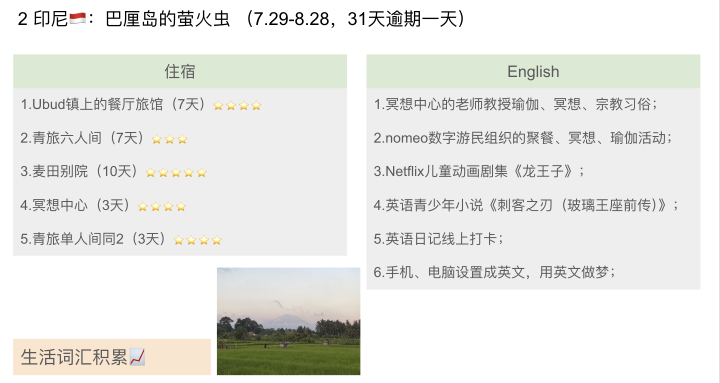
2. Indonesia 🇮🇩: Fireflies in Bali
I have already shared Bali travel experiences and visa information in Notes on Traveling in Bali.
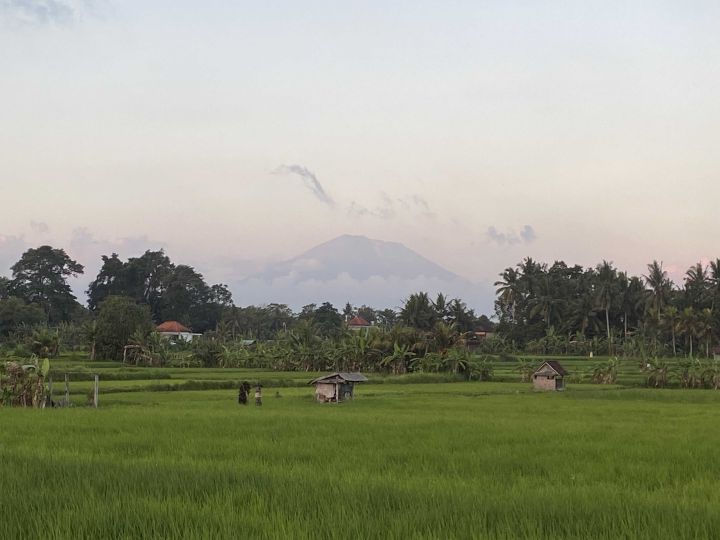
Impressions of Bali: Bali is a Southeast Asian destination very much worth visiting. The e-visa is easy to obtain; Western tourists are everywhere, providing chances to practise spoken English; there are countless quaint religious buildings, volcanoes, islands, and rice fields, as well as yoga, meditation, and massage. The food is healthy and delicious, getting around by motorbike is convenient, and the place feels like a hidden paradise from a Hayao Miyazaki animation.
In Ubud’s rice fields, huge numbers of fireflies appear at dusk. It was the first time I had ever seen so many.
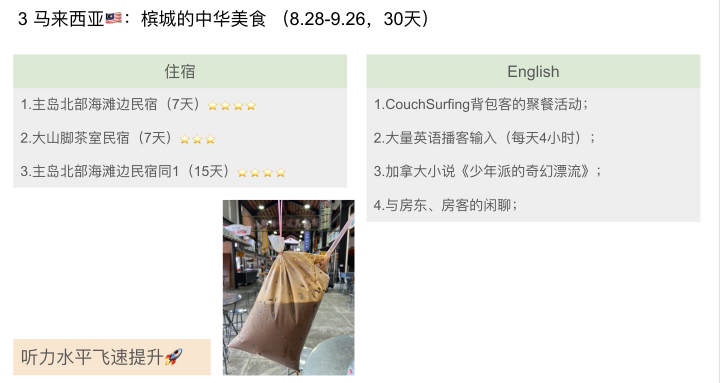
3. Malaysia 🇲🇾: Chinese food in Penang
Malaysian tourist visa: At the time, Chinese passport holders did not yet have visa-free entry. I began applying for an e-visa half a month in advance, but it was rejected because I had “no return ticket to China”—I had submitted a ticket leaving Malaysia for Thailand. With no other option, I found a visa agent on Xiaohongshu: I paid in the morning and received the e-visa in the afternoon. It was the only visa in the entire gap year for which I used an agent.
Culture: Malaysia has three main ethnic groups: roughly 70% Malay, under 20% Chinese, and under 10% Indian. Malays are mainly Muslim, and at fixed times each day one can hear prayers broadcast from mosque loudspeakers everywhere. Penang has a large Chinese population, mostly with Hokkien accents, though they also speak Mandarin.
Clothing: Summer clothes, comfortable walking sandals, an umbrella, sun protection, swimwear and a beach towel, and mosquito repellent. Many places in Southeast Asia require you to go barefoot indoors, including my homestay, so it is best to bring slippers for the room.
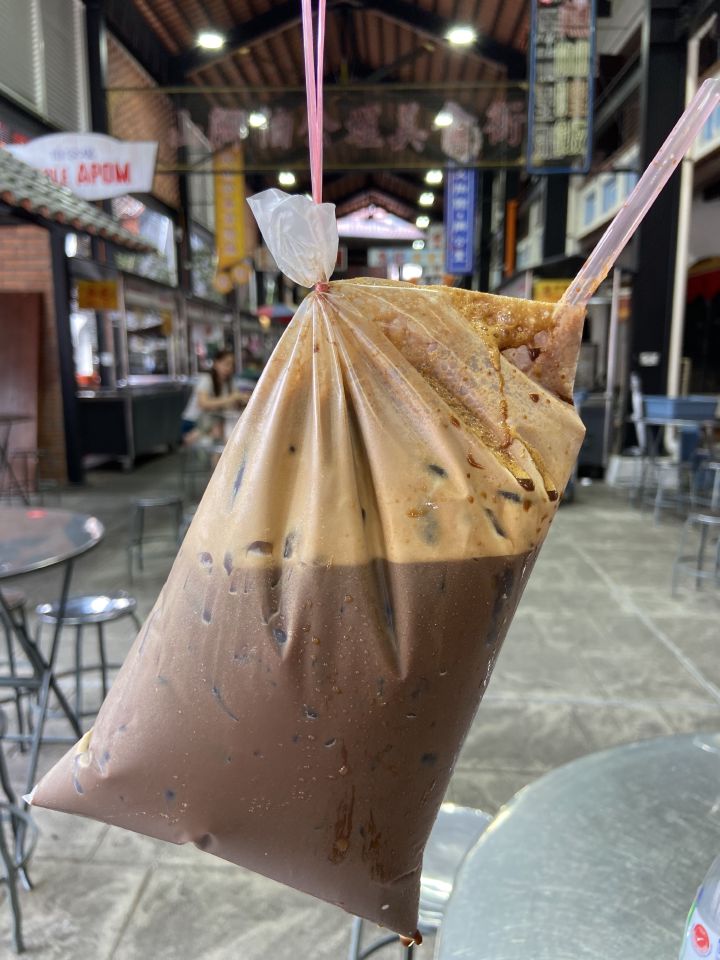
Food: Lively food night markets rotate every day, mainly with Hokkien- and Cantonese-style stalls. Some open only on Mondays; others from Tuesday through Sunday. The food is authentic and a little cheaper than roadside restaurants in Guangzhou. A food court usually has many stalls with different cuisines and one drink stall. Order from the owner at the stall and give your table number; your food will soon be brought to you. There are also many Indian and Malay restaurants, though I ate at them less often.
Accommodation: My Airbnb cost about 80 RMB per night before tax. I had a 20-square-meter room in a three-story villa by the sea, with a shared bathroom. International hostels in George Town are said to be clean and have inexpensive beds, which can be found on Booking.com.
Getting around: Grab costs about the same as ride-hailing in China, though motorbike rides are not available here. Without a Chinese motorcycle license, you may be refused a rental in Penang. As in Hong Kong, Thailand, and Indonesia, traffic drives on the left; city roads are complex, so I do not particularly recommend riding a motorbike in town. Penang buses are convenient and can be found on Google Maps. When boarding, tell the driver where you will get off and pay the fare for that stop, usually 1–2 RMB. Half of Penang is on the island and half on the mainland, linked by two sea bridges; you can take a ferry or a bus across.
Meeting people: Penang has many backpacker meetups on Couchsurfing. I attended two, both conducted in English, and had a great experience. Meetup even has local educational talks.
Recommended attraction: I highly recommend Penang National Park at the northwestern tip. A direct bus goes there. Monkey Beach inside the park is quiet and genuinely has many monkeys; the restaurant beside the beach is not expensive. Plan a full day for hiking, the beach, a boat ride, and the turtle conservation center; combination tickets are available at the entrance.
Impressions of Penang: A safe coastal city—though take care with wild monkeys and dogs in the hills—with many crows by the sea and monkeys in the mountains, the lingering call of mosques, and prices around 80% of those in China’s first-tier cities. Chinese visitors can easily fit in, Chinese palates will be comfortable, and there are many international tourists.
4. Thailand 🇹🇭: Digital nomads in Chiang Mai
Thai tourist visa: At the time, Chinese passport holders did not yet have visa-free entry, and Thailand’s e-tourist visa allowed only one month. I wanted to travel in Thailand for two months, so I applied for a sticker visa at the Thai consulate in Penang, Malaysia. There were many Chinese people in the queue, and long trousers were required to enter the consulate, but the approval rate was very high. The result came in one working day. The sticker visa allowed two months in Thailand and could be extended by another month.
Clothing: Summer clothes, long trousers for entering temples, comfortable walking sandals, and mosquito repellent. Local laundries charged about 10 RMB per kilogram and returned clothes washed and dried the next day.
Food: There were countless vegetarian restaurants: a modest meal was about 8 RMB, and an international-style meal about 20 RMB. Everyday non-vegetarian meals cost around 20 RMB too; Thai stir-fries, tom yum soup, and Thai milk tea were all inexpensive. At fruit stalls in morning markets, you could buy freshly cut, made-to-order fruit-and-honey salads for 16 RMB.
Accommodation: I stayed at “Chiang Mai Guesthouse,” a partner hostel of the Chiang Mai 706 community, by Tha Phae Gate in the Old City. Its host, Sister Zihe, was from Dali, which made me feel close to home. She took us to markets, celebrated Mid-Autumn Festival with us, made dumplings and hotpot, bought durian, and organized hired-car trips. Long-term apartments near Chiang Mai University are cheaper and can be found on Facebook.
Getting around: Bolt is recommended in Thailand; it is cheaper than Grab and offers both cars and motorbikes. Roadside tuk-tuks are not necessarily cheaper and can create communication difficulties. Renting a motorbike is easy, around 30 RMB a day for a long rental, but police check licenses at certain locations. Fines are not large, and after paying one you can continue riding for three days, which almost makes it feel like a revenue stream. Long-term bicycle rental is around 10 RMB a day. Thailand drives on the left and motorbikes share lanes with cars, so ride cautiously.
Meeting people: As an international capital for digital nomads, Chiang Mai has thriving communities everywhere. Offline options include the “Chiang Mai Guesthouse” and all kinds of coworking spaces. Online, there are Chiang Mai event listings, Couchsurfing, and Meetup.
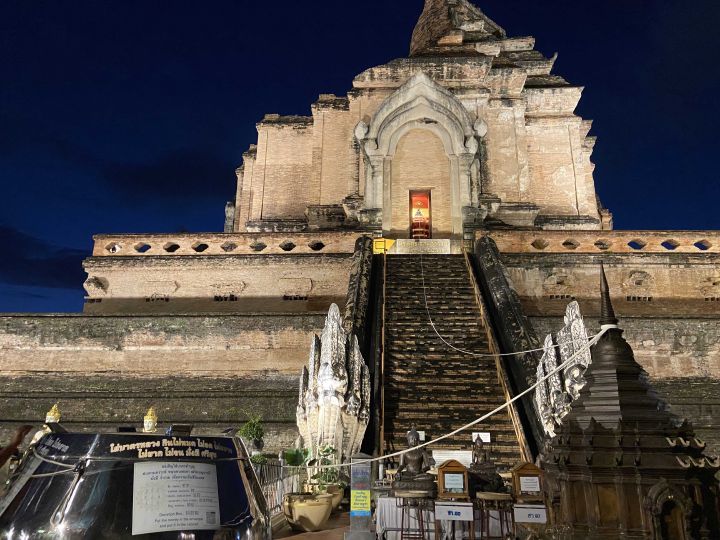
Recommended attraction: For hiking lovers, I recommend an excellent Doi Suthep hiking route in Chiang Mai. Starting at the foot of the mountain, climb through forest on Mindfulness Hill, encounter a waterfall, visit the old and peaceful Wat Pha Lat, cross a road to find the Doi Suthep Hiking Trail, climb another broad forest path, and finally reach the crowded golden-topped Wat Phra That Doi Suthep. Allow more than half a day if returning the same way.
Impressions of Chiang Mai: Lots of food, low prices, many temples, and many community activities.
5. Thailand 🇹🇭: Ten days of meditation in Bangkok
I learned about Thailand’s meditation centers while reading Like a Boat Untethered. In Fu Zhen’s writing, Bangkok is a magical city where red-light districts and places of spiritual practice coexist.
When I applied online for Vipassana two months in advance, both Bangkok and Chiang Mai were already fully booked, with waiting lists into the next year. So I chose a Vipassana meditation center in another city near Bangkok.
This chain of meditation centers teaches the method of the Indian teacher Goenka in many cities around the world. At the Thai center, his recorded instructions guided the daytime practice—first in English, then in Thai translation. Every evening, a two-hour video lecture in English with Thai subtitles reviewed the day’s practice, told stories of Indian spiritual practice, explained the Buddhist worldview, and prepared us for the next day. Other languages, including Chinese, had separate small rooms but only audio.
I worried that I would not understand Indian-accented English, so a month in advance I began looking for Goenka podcasts to listen to, getting used to his speech and familiarizing myself with his common vocabulary.
The full meditation course lasted twelve days and eleven nights. On the first day, we took a bus from Bangkok, handed in our phones and valuables to be locked away, and began ten days and nights of practice on the second day. On the morning of day twelve, after the early session and breakfast, we collected our phones and belongings and formally finished the course before returning to Bangkok.
Partitions and greenery divided the center in two: men on the left and women on the right, completely separate for meals and accommodation, and seated on opposite sides of the classroom. During the ten-day course, we could not speak, make eye contact, read, or listen to music, reducing every form of information input.
- Wake at 4 a.m.; the early session began at 4:30 and ended at 6:30 for breakfast.
- The morning session began at 8 a.m.; lunch was at 11.
- During the midday break, we rested in the dormitory or meditated alone on the cushion in our room.
- The afternoon session began at 2:30 p.m.; dinner was at 5.
- The evening session began at 6 p.m.; we returned to our rooms to sleep at 9:30.
Breakfast and lunch were vegetarian, with abundant, nutritious, delicious vegetables—the most varied vegetarian food I had ever eaten. Only new students could have dinner; old students drank only lemon water. We stayed in private rooms with excellent conditions: en-suite bathrooms, meditation cushions, small balconies with taps, ceiling fans, clothes hangers, buckets, brushes, and brooms. We could wash clothes ourselves or pay the administrator to have a laundry company do it.
The hardest parts of the course were sitting cross-legged for long periods—up to two continuous hours—and resisting the constant drifting of attention and irritation. Of course my legs went numb. I did poorly: I had to change legs in under half an hour, and endless impatient thoughts arose. The principles seemed understandable, but I could not sustain the practice. Some people gradually gave up and left. I forced myself to stay until the end, telling myself this was a once-in-a-lifetime experience.
Goenka was born into a wealthy Indian family but had a congenital illness whose physical pain could not be cured with medicine. He therefore learned this meditation method from his teacher, seeking liberation amid bodily pain. He later spread it among Indian people living in hardship, helping ordinary people find relief from the boundless suffering of worldly life. I understood that the numbness in my legs during meditation was trivial compared with Goenka’s own pain. He lived with it with nowhere to escape, able only to coexist with it and practise.
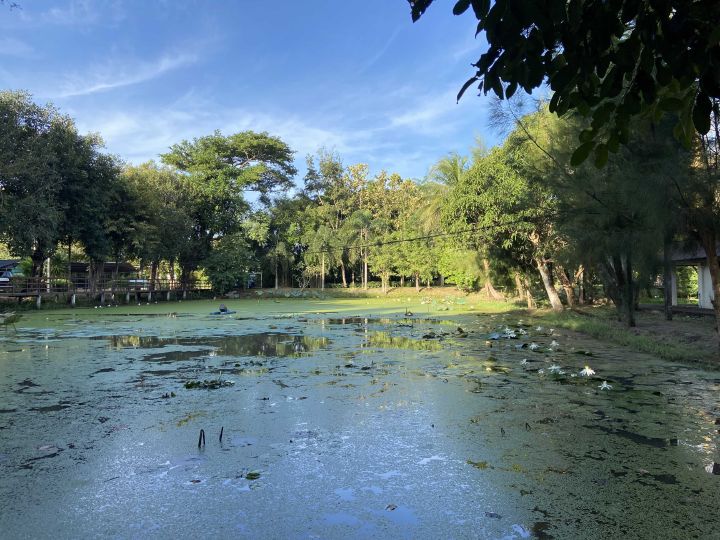
After the course, beside a lotus pond, a Thai uncle told me in English that it was his second time attending. The first time, while his legs were numb, he had experienced a vibration throughout his body and gained some insight. I had no particular realization, so I will say no more. But as the course progressed, I felt ever more strongly that my mind was beyond my control: it was like a powerful, fierce beast, and my will still could not hold its reins.
6. Laos 🇱🇦: Villagers in Luang Prabang
I had not expected the Airbnb I booked to be in such a remote little village, ten kilometers from Luang Prabang’s town center. The village had only three small restaurants selling local rice noodles, cheap but questionably tasty roadside barbecue, and a few dusty snacks in a tiny convenience store.
There I met my enthusiastic Lao host, a German couple traveling in a camper van with their baby, and a Taiwanese woman who spoke fluent American English.
The host had worked for a local French agricultural company for twenty years. He learned about Airbnb from his French colleagues, renovated his house and rented out four rooms. With the help of his first European guest, he improved the room layouts and promotional photos, and received increasingly positive reviews. He said that meeting guests from around the world gave him access to much information difficult to get locally.
The German couple’s baby was fourteen months old. Both were nurses and had taken two years of paid parental leave. They drove their camper van from Europe through China to Laos. Wearing flip-flops and carrying their baby, they crossed mountains and valleys in the Lao jungle with me, looking for signs of elephants and eating sticky rice at villagers’ homes.
The Taiwanese woman had also quit her job to travel alone. Later, she spent three days touring Laos by motorbike, then took a bus to Hanoi, Vietnam. Laos has poor infrastructure and many potholes; on the road to Kuang Si Falls, tourists often ride too fast and crash. But the road from the village to town was good: I rode at 60 km/h every day and reached the center in fifteen minutes.
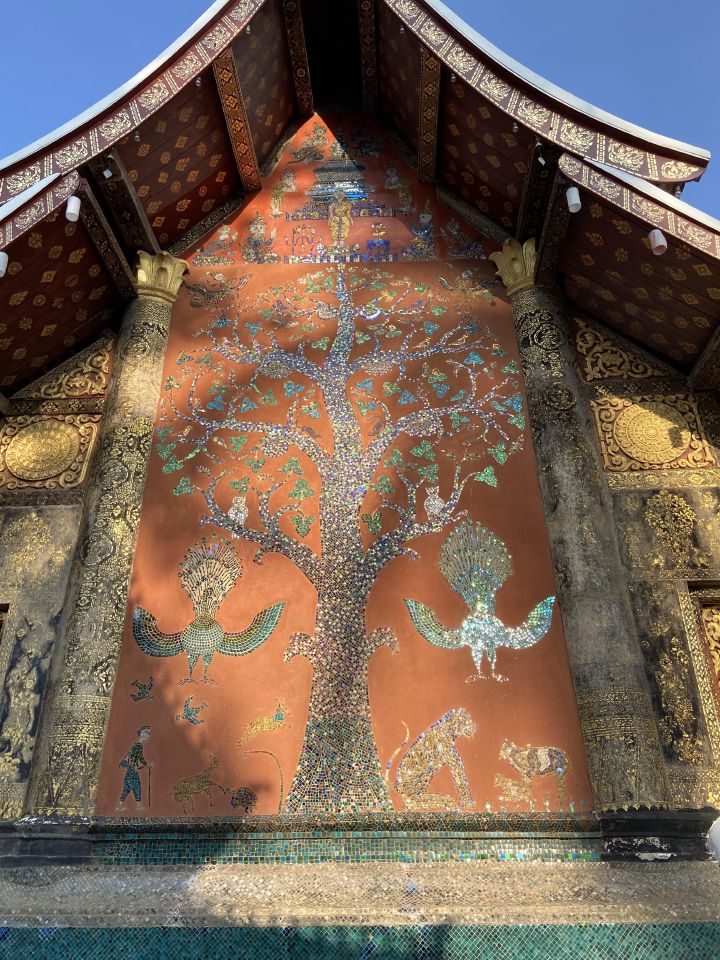
Laos was once a French colony, so Luang Prabang’s center retains many French buildings. It is small and full of temples, cafés, bakeries, and guesthouses. Following Fu Zhen’s footsteps, I visited Wat Xieng Thong and paused to admire its colorful phoenix made from glass mosaics. Though it is a famous destination, Luang Prabang feels lazily peaceful—perhaps because it has no skyscrapers or congested traffic, and visitors gather only on one commercial street in the evenings.
I often went to MyLibrary, a nonprofit library that helps local children learn English, photography, and computer skills. The first floor was a computer area, where I often saw young monks from nearby temples watching YouTube and children playing board games. The second floor was for books. I often saw a Western family there: the father sounded American, the mother spoke French, and the father taught their daughter English with such an encouraging style. The library sold inexpensive used English books and allowed exchanges for your own English books. I found five or six there, each for around 15 RMB. Reading on the second-floor balcony, I sank into the town’s lazy afternoons.
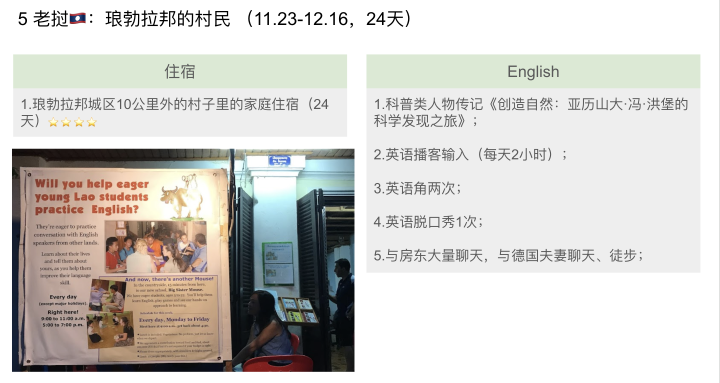
The town also had an English corner called Big Brother Mouse, twice a day in the morning and evening. Tourists volunteered by speaking English with Lao children and helping them practise. I went twice, and we exchanged our understanding of one another’s worlds.
Lao visa: You can apply through the official Lao eVisa website, or get a visa on arrival. Both allow a one-month stay.
Clothing, food, accommodation, and transport: The climate is a little closer to China’s; autumn can be cool, and spring and summer are said to have air pollution from burning fields. Food in town and around attractions is varied and cheap. I recommend staying at a guesthouse in town; it is quiet even there. Taxis are very expensive—far more than in China—so rent a motorbike, but ride slowly and watch for potholes.
Impressions of Luang Prabang: A small town beside the Mekong, with beautiful nearby waterfalls. Beyond the town, everything becomes quite remote; forest covers a large area and it is easy to get lost, so much so that my host worried about me hiking wild hills alone. Prices are low and the pace is so relaxed that there is nothing to do. There are many European and elderly visitors, bookstores have many French books, and it suits people who like quiet and French learners.
7. Two months back in China (U.S. visa interview)
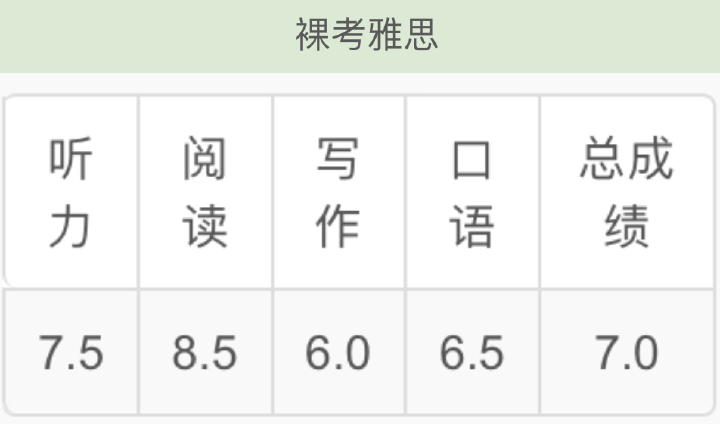
On returning to China, I first spent ten days in Guangzhou. Two things happened there: I took IELTS without preparation to test the results of six months of English study, and I attended a U.S. visa interview at the American consulate—an appointment I had booked six months earlier.
I did not think of applying for a U.S. visa until I resigned in June. It would make travel in Latin America much easier, because a U.S. visa allows direct entry to most Latin American countries. But after submitting the DS-160, I discovered that U.S. visa interviews in Guangzhou were booked six months ahead, so I scheduled the Latin American portion for after the Spring Festival.
I prepared the U.S. visa application entirely myself. I had no job, was single, and came from a sensitive field, so I did not feel very confident that I would get it. Still, I had to try and see what the universe had arranged.
- Fill in the nonimmigrant visa application form (DS-160) on the U.S. Embassy website to obtain a form ID. This is crucial; see BIT’s DS-160 instructions for detailed guidance.
- Register an account on the U.S. Visa Information Service, link the DS-160 form ID, select a U.S. consular district and book an interview, pay the fee, and provide a passport-delivery address.
- Attend the consular interview. You may be refused on the spot, approved and have your passport retained, or have your passport retained while being asked to provide additional materials.
Applying for a U.S. visa yourself is not difficult. The main requirements are English ability, completing the DS-160 carefully, and giving answers consistent with the form in the interview. No proof of assets was required, although I prepared bank statements. Since I thought I would only transit the United States, I did not include a travel plan on the DS-160; the in-person interview consequently required supplementary materials.
The English interview was simple, with only four questions: why I was going to the United States, the name of my previous company, my educational background, and whether I had visited other countries. When asked why I was going, I honestly said that I would transit the U.S. while traveling in Latin America. I was not approved immediately. The visa officer asked me to email the embassy a detailed résumé—including papers published during university—and a travel plan. A month later I received a text message to collect my passport. Only when I opened it and saw the visa page did I know I had passed the interview, although I received only a one-year visa.
Next, I spent a month in Dali Old Town. I wanted to develop a podcast app good enough for listening to foreign-language podcasts; Xiaoyuzhou is mainly Chinese, while Apple Podcasts’ playlist and in-podcast search functions left much to be desired. I stayed in a guesthouse on Sanyue Street, wrote code by day, ate vegetarian lunch at Dashixiong’s, had vegetarian dinner at Bensu Canteen, and walked beneath Cangshan Mountain while listening to podcasts after dinner.
When the podcast app was formally released, I returned home to reunite with my family for the Spring Festival. I also received my U.S. visa by courier and began planning the post-holiday Latin American journey.
8. Mexico 🇲🇽: Four months of studying Spanish
How can you quickly integrate into local life when traveling in Latin America? The 4-Hour Workweek recommends several approaches: learn the local language, learn a famous local sport or dance, or join local volunteer, NGO, or other social-service organizations.
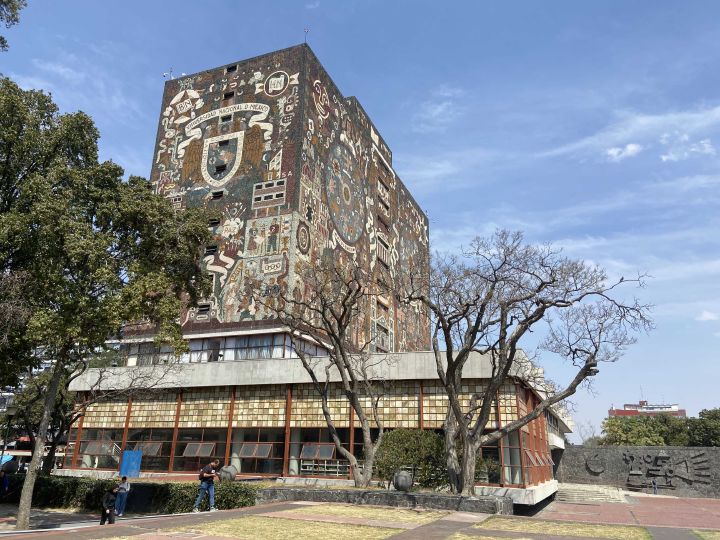
I chose Spanish and enrolled at the Center for Teaching for Foreigners (CEPE) of UNAM, a leading Latin American university.
Choosing a language school:
- According to recommendations for Spanish schools in Latin America on Xiaohongshu, Spanish schools in Guatemala offer the best value: beautiful scenery, room and board included, and well suited to short-term study while traveling. CEPE’s advantages are strong faculty and systematic teaching. Enrolled students take a placement test and are assigned to levels 0 through 8. Each level lasts six weeks and 126 class hours, with usually no more than ten students. If you fail the final exam, you cannot advance and must pay to retake the term. It suits people who want to study Spanish solidly and live in Mexico long term.
- CEPE has two campuses, Planco and CU. Planco is in a business district of Mexico City, more expensive and suited to business people. CU, short for Ciudad Universitaria, is the main campus beside UNAM’s famous Central Library and is cheaper. I chose CEPE CU’s in-person Curso presencial Intensivo de Español, a two-month term with three hours of Spanish class and one and a half hours of electives—pronunciation, theatre, history, or art—every Monday to Friday. A term cost about 7,000 RMB. You could pay online with a U.S. PayPal account but not a Chinese Visa card; alternatively, register and pay at the school two working days before classes as instructed by email, where the POS machine accepted Chinese Visa cards.
- The school gives you contacts for housing agents, but you must arrange accommodation yourself. I used Airbnb and lived with a middle-class family near the school for 3,500 RMB a month, a fifteen-minute walk from class. If you contact an agent yourself, nearby monthly rents are usually 2,000–3,500 RMB.
- When registering at CEPE, the school photographs you for a student ID. The card grants free or half-price entry to many museums in Mexico City. CEPE’s largest groups of students came from China, African countries, and Korea, followed by Japan and Russia, then the United States, the United Kingdom, and Australia. Students from different countries usually spoke Spanish with each other, mixed with English. Students could also attend some UNAM cultural performances, including theatre and concerts, for free.
Latin American visas: A U.S. visa is almost a pass to Latin America. Mexico and Peru allow entry with a U.S. visa that has more than six months remaining, while Argentina allows an online e-tourist visa application with one. Guatemala has no diplomatic relations with China, so a tourist visa must be obtained in a third country. On arrival from the United States, Mexican immigration asks how long you plan to stay and can grant up to six months. I said three months and received three.
Clothing: March through June is spring in Mexico. The first two months were dry and hot; the latter two gradually entered the rainy season. When it did not rain, there was much dust, poor air quality, and intense dryness. I had to apply body moisturizer after showering every day or my skin would peel. During the first two months, I got nosebleeds every night and often woke up unable to breathe because of them; it improved only in the rainy season. Mexico City is 3,000 meters above sea level, so mornings and evenings are cool and locals often wear light down jackets. Yet the dryness makes it feel less cold, and you can manage in a T-shirt. A reasonable outfit is short sleeves at midday, long sleeves in the morning and evening, a jacket and thin down coat for rainy days, and a down jacket for volcano hikes above 5,000 meters.
Food: Overall living costs were more than 1.2 times those in China’s first-tier cities, and I saved money almost entirely by eating tacos every day. Tortillas are a traditional staple. Street taco and burger stalls are common; I quite liked tacos, though hygiene at street stalls varied and diarrhea was common. A street-stall taco meal was usually 24 RMB, with iced Coke for 8. Mexican restaurants were not actually expensive: 44 RMB bought a comfortable everyday meal. Korean ramen near the university cost around 50 RMB a bowl, Chinese fast food about 60 RMB, and a better Chinese restaurant around 100 RMB per person. Overall, many Chinese people may not be used to Mexican food. I do not recommend street stalls; I recommend Mexican restaurants with storefronts. English is not widely spoken, however, and most ordinary restaurants operate only in Spanish.
Accommodation: Airbnb rooms cost more than 120 RMB per night before tax, making this the most expensive city I stayed in. Local beds also used several layers of blankets without duvet covers, with only a sheet against the body. I found that unfamiliar, and the bedding easily came apart when made each morning. Some bathrooms used solar-heated water, which took a long time to warm up; electric water heaters were much quicker.
Getting around: Uber was the most expensive, followed by DiDi’s overseas service; both were more expensive than in China. Public transportation, however, was very cheap: metro and buses were 2 RMB regardless of distance. Google Maps could find routes, and metro cards could be bought and topped up at machines by station entrances. Shared bicycles were available in the central city, with an annual rental under 200 RMB. Yet transport was also what locals complained about most: traffic jams, packed metros and buses at commute times, and many people transferring several times over an hour and a half to get to work.
Impressions of Mexico City: The descriptions above may make its everyday necessities sound unsatisfying, but Mexico left me with a very high overall impression.
- Local people are extraordinarily warm and very willing to help strangers without expecting anything. On my first day in Mexico City, I took the metro to my accommodation to save money. As I studied the Spanish instructions beside a machine to work out how to buy a metro card, a passerby asked if I needed help and simply gave me his own card. When I went hiking in a national park and looked around for restroom signs, someone immediately came over and asked whether we needed help.
- It is LGBT-friendly. I saw same-sex couples on buses and in parks, while heterosexual couples sweetly hugging and kissing in public were even more common.
- The sunshine is brilliant, much like Dali, and lifts the mood. Though the climate is dry, green space is extensive.
- The artistic atmosphere is strong. Streets are full of murals—not graffiti—there are countless museums of every size, bookstores are everywhere, and free music and art festivals are frequent. It is easy to encounter people reading on the metro.
That concludes this gap year. Finally, I will end with a few words, again quoted from episode nine of season one of Thirteen Invitations, A Conversation with Yu Feihong:
Yu Feihong: Though saying this may not be very good for young people, in fact life has no meaning.
Host: I rather like a Western tradition of thought: they believe that life is a Permanent Struggle, an endless struggle that can never be calm. So they must remain entangled throughout their lives. They use creativity to face death and overcome this meaninglessness.
Author Harold Gao
LastMod Nov 16, 2024